What is Insurance Fraud?
Insurance Fraud is the deliberate falsification of information by a claimant in order to obtain a financial advantage or gain. Insurance Fraud ranges from overstating the value of damaged or lost items or not declaring information that is known and relevant to a claim, through to the activities of highly organised criminals coordinating large and complex false claims.
Insurance Fraud can be:
- Opportunistic – the padding and exaggeration of otherwise legitimate claims
- Premeditated – Arson, theft, staged incidents involving the fabrication of a claim
- Based on Non-Disclosure – Misrepresenting or hiding facts relevant to a claim
Insurance Fraud – A Victimless Crime?
Many in the community believe that insurance fraud is a victimless crime, that the only ones to suffer a loss are large faceless insurance companies.
In research carried out by the Insurance Council 25% of people interviewed claimed to know somebody who has committed insurance fraud, 20% endorsed the padding or exaggeration of an insurance claim and 38% believed that insurers can afford the cost and that there are no losers.
However, insurance fraud is a cost on the provision of insurance that ultimately contributes to the cost to members of the public through higher insurance premiums.
Getting Caught
Evidence in Australia suggests that up to 10-15% of claims exhibit fraud ‘indicators’.
Understandably insurers undertake sophisticated anti-fraud measures and will investigate activity believed to be fraudulent. Insurers work closely with law enforcement in each jurisdiction to ensure that appropriate action is taken when fraud is proven to have occurred.
The penalties for a fraud conviction may vary from State to State, but all are classified as serious indictable offences which can result in substantial custodial sentences if convicted.
Monday, October 11, 2010

Sunday, October 10, 2010
Improve Insurance Claim Handling and Fraud Detection
Improve Insurance Claim Handling and Fraud Detection
For property and casualty insurance companies, the key to customer satisfaction is settling claims quickly. In fact, a survey by Accenture revealed that most property and casualty insurance claimants prioritize the speed of claim resolution over the settlement amount offered (Accenture, 2002).
Reduce claim cycle times and minimize claim handling costs
PredictiveClaims enables you to increase customer service by reducing claim cycle times. And by reducing claim settlement times, you also minimize claim handling costs and loss adjustment expenses (LAE). At the same time, PredictiveClaims helps you conduct more effective claims fraud detection, and make more efficient use of field agents and your special investigation unit.
With Predictive Claims, property and casualty insurers can:
* Quickly approve legitimate insurance claims to improve customer service and minimize loss adjustment expenses and claim handling costs
* Identify fraudulent insurance claims at an early stage with a high degree of accuracy—even with large claim volumes
* Understand why certain claims are flagged as suspicious, so your special investigation unit know where to focus its investigations
* Combine and analyze data from multiple internal and external sources, including federal and insurance industry databases
* Integrate with existing claims management systems without extensive customization or lengthy implementation periods
Detect claims fraud at an early stage
With PredictiveClaims, you determine whether claims are legitimate or fraudulent at an early stage—often in the initial customer conversation. PredictiveClaims integrates with your existing claims management system to deliver risk-based scores in real time, along with reasons for the score. Even with very high claim volumes, PredictiveClaims’ advanced analytics accurately determine whichclaims to settle quickly—and which require follow-up or investigation.
Improve the productivity and accuracy of claims handling
With PredictiveClaims, property and casualty insurance companies can improve the productivity and accuracy of the entire claim handling process—from first notification of loss to claim settlement—regardless of whether claims are submitted via telephone, fax, mail, the Internet, or in person.
Saturday, October 9, 2010
Pharmaceutical & Insurance Fraud
Medical, Pharmaceutical, Health Insurance Fraud
Types of Fraud
1) Billing: Inflated, Double, Phantom, Unbundling, for unnecessary equipment or procedures
2) No Fault Claims Insurance: Provider fraud, insured persons fraud
3) Malpractice in conjunction with fraud: malpractice must occur after and separately from malpractice
4) Pricing: Medicare/Medicaid, FDA
5) Violations of Anti-kickback law: Physician paid referral, E-health website regulations
Acts, Statutes, Laws
1) Anti-kickback law
2) False Claims Act (Qui Tam/Lincoln Act)
3) No Fault Claims
4) “Whistleblower Protection”
5) Drug Pricing Program and Prescription Drug Marketing Act
6) Food, Drug, and Cosmetic Act
Case Studies
1) Pfizer – Warner Lambert Division
2) Schering-Plough
3) Astrazeneca
4) Bayer
5) GlaxoSmithKline
6) Tap Pharmaceutical Products
7) PharMerica Inc.
8) King Pharmaceuticals
9) Eli Lilly and Co.
(First 9 are major pharmaceutical fraud cases violating False Claims Act)
10) Ackerman v. Metropolitan Life Ins. Co.
11) Wickline v. State of CA
12) Simcuski v. Saeli
13) Detwiler v. Bristol Myers Squibb Co.
Strategies of Prosecution
1) Billing/Insurance Fraud (Violations of False Claims Act): Provide evidence of inflated, doubling, or unbundled billing, or arrangement between patient and physician to receive free services for Medicaid/Medicare insurance number. Proof of feigned injuries or treatment by secondary medical reviewer for insurance claim.
2) Proving Fraud in a Medical Malpractice suit: Provide evidence that physician had intentionally concealed prior malpractice or made factual misrepresentations regarding a previous malpractice, leading to faulty therapy or cure that patient justifiably relied upon, leading to patient damages. Must be separate and distinct from damages from the current malpractice case in question. (Simcuski v. Saeli)
3) Anti-kickback Law Violations: Provide evidence of any compensation a physician may have received in exchange for recommending a product – in the form of financial incentive, paid “vacation” conferences, “consulting fees,” etc.
4) Off-Label Marketing (Violations of Food Drug and Cosmetic Act): Pharmaceutical products not approved by the FDA for an intended use may be prescribed for a primary or secondary use by physicians, but are not eligible for reimbursement and are prohibited to be marketed by pharmaceutical companies. Any evidence otherwise would suggest fraud.
Defense Strategies
1) Medical Malpractice versus Medical Fraud: Damages from fraud in a medical malpractice action must be separate and distinct from damages from malpractice. Fraud often dismissed in place of malpractice. NY Law maintains that to establish a claim of fraud, the patient must show elements of fraud and that physician knew of own malpractice and deliberately concealed malpractice, resulting in misguided recommendations/therapy that led to patient damages. Only in this context does fraud apply.
2) No Fault Claims, Overbilling, Excessive Treatment: Insurer should prove lack of claims’ medical necessity in treatment or price. Insurer may submit a claim denial form to Commissioner of Health within 30 days after Insurer has knowledge of patterns of overcharging or excessive treatment. Burden of Proof for overcharging and excessive treatment rests on Insurer and its counsel.
3) Anti-Kick Back Law Defense for E-health Co.’s Referring Physicians: Must show that referral service did not exclude any participants who qualified, did not receive differential payments by participants, did not require the participant to provide services to a referred person, and/or made disclosures to the patient seeking the referral. In general, to show that both E-health Company and physician are “recommending” pharmaceutical products to patient and no quid pro quo arrangements occurred.
Types of Fraud
1) Billing: Inflated, Double, Phantom, Unbundling, for unnecessary equipment or procedures
2) No Fault Claims Insurance: Provider fraud, insured persons fraud
3) Malpractice in conjunction with fraud: malpractice must occur after and separately from malpractice
4) Pricing: Medicare/Medicaid, FDA
5) Violations of Anti-kickback law: Physician paid referral, E-health website regulations
Acts, Statutes, Laws
1) Anti-kickback law
2) False Claims Act (Qui Tam/Lincoln Act)
3) No Fault Claims
4) “Whistleblower Protection”
5) Drug Pricing Program and Prescription Drug Marketing Act
6) Food, Drug, and Cosmetic Act
Case Studies
1) Pfizer – Warner Lambert Division
2) Schering-Plough
3) Astrazeneca
4) Bayer
5) GlaxoSmithKline
6) Tap Pharmaceutical Products
7) PharMerica Inc.
8) King Pharmaceuticals
9) Eli Lilly and Co.
(First 9 are major pharmaceutical fraud cases violating False Claims Act)
10) Ackerman v. Metropolitan Life Ins. Co.
11) Wickline v. State of CA
12) Simcuski v. Saeli
13) Detwiler v. Bristol Myers Squibb Co.
Strategies of Prosecution
1) Billing/Insurance Fraud (Violations of False Claims Act): Provide evidence of inflated, doubling, or unbundled billing, or arrangement between patient and physician to receive free services for Medicaid/Medicare insurance number. Proof of feigned injuries or treatment by secondary medical reviewer for insurance claim.
2) Proving Fraud in a Medical Malpractice suit: Provide evidence that physician had intentionally concealed prior malpractice or made factual misrepresentations regarding a previous malpractice, leading to faulty therapy or cure that patient justifiably relied upon, leading to patient damages. Must be separate and distinct from damages from the current malpractice case in question. (Simcuski v. Saeli)
3) Anti-kickback Law Violations: Provide evidence of any compensation a physician may have received in exchange for recommending a product – in the form of financial incentive, paid “vacation” conferences, “consulting fees,” etc.
4) Off-Label Marketing (Violations of Food Drug and Cosmetic Act): Pharmaceutical products not approved by the FDA for an intended use may be prescribed for a primary or secondary use by physicians, but are not eligible for reimbursement and are prohibited to be marketed by pharmaceutical companies. Any evidence otherwise would suggest fraud.
Defense Strategies
1) Medical Malpractice versus Medical Fraud: Damages from fraud in a medical malpractice action must be separate and distinct from damages from malpractice. Fraud often dismissed in place of malpractice. NY Law maintains that to establish a claim of fraud, the patient must show elements of fraud and that physician knew of own malpractice and deliberately concealed malpractice, resulting in misguided recommendations/therapy that led to patient damages. Only in this context does fraud apply.
2) No Fault Claims, Overbilling, Excessive Treatment: Insurer should prove lack of claims’ medical necessity in treatment or price. Insurer may submit a claim denial form to Commissioner of Health within 30 days after Insurer has knowledge of patterns of overcharging or excessive treatment. Burden of Proof for overcharging and excessive treatment rests on Insurer and its counsel.
3) Anti-Kick Back Law Defense for E-health Co.’s Referring Physicians: Must show that referral service did not exclude any participants who qualified, did not receive differential payments by participants, did not require the participant to provide services to a referred person, and/or made disclosures to the patient seeking the referral. In general, to show that both E-health Company and physician are “recommending” pharmaceutical products to patient and no quid pro quo arrangements occurred.
Friday, October 8, 2010
Insurance Scam Fraud Protection
Insurance Scam Fraud Protection
If you become a victim of car insurance fraud, you pay. Not only will you pay higher premiums because you may acquire a costly claim, but, as with any car accident, you and your family could pay with your lives. It is important to learn more about fraud protection so you can protect yourself from others who may choose you to be a part of their next car insurance accident fraud scam.
Insurance fraud began when insurance first began. Incidents have been recorded as far back as ancient Greece. Ship scuttling was an insurance scam in ancient Greece where ships were purposely sunk. Later insurance fraud traveled to England then to America. When automobiles were introduced it opened a whole new arena for fraudulent insurance claims. Today, with modern technology, many fraudulent car accident claims do arise from sophisticated organized crime rings that can be hard to detect. Don't let this make you a victim of an insurance scam. Whether the insurance scam is from an organized crime ring or an individual, there are fraud protection steps you can take to help you be more aware and avoid being a scammer’s next victim.
First, it is important to know what types of insurance scams are used. There are many types of car insurance scams. Set-up car accidents can range from vehicles deliberately stopping in front of a driver to cause a rear-end car accident to drivers who pretend they are being helpful but intend to cause a car accident that will look like the innocent drivers fault. Scams can also involve people one would generally trust such as doctors and lawyers.
Educating yourself more about fraud protection against car insurance accident scams is the best way to avoid being someone's next victim. Here is a list of common scams to be aware of:
Since these scams can happen at any time and place, it is important to be prepared. Awareness is the most important. Watch for drivers who may be following you or examining your driving habits. Also, make sure you leave plenty of room in front of you in order to stop. If an accident does happen, take notes on everything about the other car, the accident, and everybody that was in the other car. Keep a disposable camera in your car to record damage to both vehicles. Furthermore, use your judgment in driving, not others. Make sure you have enough room to get out and just let other cars pass instead of letting others "waive you in." And, when you talk to your insurance company, let them know if you felt something was suspicious.
Tuesday, June 9, 2009
Insurance Fraud Watch Newswire
Private Prosecutions in New Zealand
There is a little-known New Zealand law in which a prosecution for fraud which was not pursued by the government, usually due to budget constraints, can be privately-financed. Furthermore, there is no statute of limitations on bringing an action for fraud. This means the action could be filed 10 or more years after the incident. Not good news for fraudsters who think they are safe because some time has passed. Persons affected by fraud are increasing taking advantage of this law to administer justice to fraudsters.
"The Joneses" Goes Bust; Steve Nichols Loses Big $$$
Auckland-based real estate company “The Joneses” collapsed on February 18 under a mountain of debt estimated at several million dollars. The company was based in an office in the so-called “Oracle Tower” (all 18 floors of it), which was being sub-let to them by none other than “The Three (alleged) Fraudsters;” Mike Henry, Steve Nichols, and Murray Calder, who sub-let it to the Joneses
 after they sold their travel insurance business to Insurance Australia Group (IAG) in 2006. The whopping $275,000 annual rent will have to be paid by The (alleged) Fraudsters out of their own pockets until they find a new tenant, or until their own lease runs out in 2012, which will not be easy, given the poor state of the NZ real estate market.
But that’s not the funniest part.
It has been revealed that Steve Nichols, currently employed by Medtral New Zealand Limited, http://www.medtral.com, after coming untethered from Mike Henry’s rear end almost two years ago, has been attempting to play venture capitalist, as one of the unlucky investors in “The Joneses”. Nichols' loss: an estimated $500,000.
We’re waiting to see if Nichols' other investment, kitchen cleaning product franchise "Brilliance Corp.", turns out to be as Brilliant an investment as “The Joneses”. One thing is for sure: Steve Nichols isn't Brilliant; he's not even bright, judging by the soundness of his investment decisions and the spelling mistakes on the anonymous emails he's sent to The Moderator. Time to put your remaining money in a time deposit Steve, and leave venture capital to the professionals.
 Coming Soon To a Bookstore Near You...More
Advance orders are now being taken for "Serial Fraudster" the Mike Henry Investigative Report, to be published by a major publisher. The tell-all account is sure to rock the insurance industry and send some heads rolling, as it reveals the names of those who continued to do business with Mike Henry, Steve Nichols (currently employed by Medtral New Zealand Limited, http://www.medtral.com), and Murray Calder, after evidence of criminal activity was presented to them.
Thanks to a private donation, all public libraries in New Zealand will be provided with a free copy of the book, as will all of Mike Henry, Steve Nichols, and Murray Caulder's neighbors in Auckland and Queenstown.
Mike Henry Travel Loses Top Client; IAG Feels the Pain
Insurance Australia Group was cautioned to not do business with Mike Henry. Now IAG is feeling the pain. Mike Henry Travel Insurance Limited, the company IAG bought from the aging con-artist, recently lost their largest client, Flight Centres, and some 40% of MHTI’s revenue, to travel insurance provider Covermore. Who is covermore? A company that was once owned by none other than...Mike Henry. We told you so IAG...time to re-think those other deals you're doing with the slithering Henry.
Insurance Fraud Watch Achieves Top Rankings on All Major Search Engines; Surpasses 40,000 Visitors in less than 18 Months 6-July-2007
As of July 2007, Insurance Fraud Watch now comes up in the top 10 rankings of nearly every combination of relevant key words on all major search engines, and is number 1 in many.
For example: Interglobal Limited, #12, Mike Henry Travel Insurance #6, Rotary International Ethics #6, Mike Henry Fraud #1.
Mike Henry Explodes With Anger as Blog Post Hits a Raw Nerve
The prospect of the forthcoming book exposing his criminal exploits to a worldwide audience prompted an unprecedented tongue-lashing from Mike Henry, in the form of an anonymous post in the Comments section herein. (see the Comments section, below). The scathing diatribe, which was traced back to Interglobal Limited’s server 194.72.134.202, located in Bromley, U.K., underscores Mike Henry’s elevated level of concern.
Mike Henry and Steve Nichols Resign from Interglobal Board Under Pressure
Mike Henry and Steve Nichols (currently employed by Medtral New Zealand Limited, http://www.medtral.com) resigned from Interglobal's board on March 19, 2007. Inside sources reveal that the resignations came as a result of pressure from the private equity investors and other shareholders concerned about the mounting evidence of criminal activity on the part of Mike Henry and Steve Nichols, and the negative impact it will have have on their budding insurance venture, Interglobal Insurance Company Limited, should the FSA blacklist Messrs. Henry and Nichols. Mike Henry and Steve Nichols are still hiding under rocks as Interglobal shareholders and puppeteers, however. Steve Nichols is now putting his management skills to the test as a distributor of a new miracle kitchen appliance cleaning product in New Zealand.
Some Recent Search Engine Keywords Which Brought Visitors to This News Blog:
update criminal charges on steven nichols mike henry
iag state insurance new zealand complaints
uk health insurance fraud investigators
"mike henry" "new zealand" articles
deborah henry nz methamphetamine
new zealand organised crime and gang name index
stephen hartigan insurance
insurance australia group" "major shareholders"
"michael paul henry"
the four way test
latest list of fraud in new zealand through the police
ird internet gallery scam
how caught insurance fraud investigated forum
Medtral New Zealand Limited, http://www.medtral.com
Interglobal Visitors Top the Rankings to this News Blog During August, 2007.
Some 54 visits were made to this news blog by persons logging on from Interglobal Limited's server 194.72.134.202 during August, a record from a single IP address.
The information in this blog is factual, true and complete. Please bring any inaccurate postings to the attention of the moderator: insurancewatch@gmail.com, and include documented evidence of any inaccuracies so that they may be corrected. Undocumented objections will not be published, nor read.
Monday, September 4, 2006
Risky Business: RSA Puts Their Reputation On The Line
Royal & Sun Alliance Insurance has taken the risky step of going into business with criminal fraudsters Mike Henry and Steve Nichols.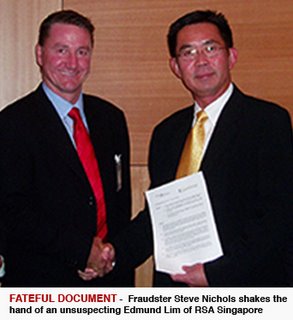
The tie-up is allegedly to sell Interglobal Insurance to unsuspecting expatriates residing in Singapore and China.
Apparently the pursuit of potential income has superseded the insurer's obligation to its shareholders and the public to do business only with ethical parties. Either that or RSA's due diligence process has failed miserably. What is unknown at this point is how RSA intends to explain this to the Chinese and Singaporean insurance regulators, and why they are putting their entire business operation in those jurisdictions at risk for the sake of a relatively small amount of potential income.
Comments from insurance regulators will be posted here as they become available.
More Details: Click Here

The tie-up is allegedly to sell Interglobal Insurance to unsuspecting expatriates residing in Singapore and China.
Apparently the pursuit of potential income has superseded the insurer's obligation to its shareholders and the public to do business only with ethical parties. Either that or RSA's due diligence process has failed miserably. What is unknown at this point is how RSA intends to explain this to the Chinese and Singaporean insurance regulators, and why they are putting their entire business operation in those jurisdictions at risk for the sake of a relatively small amount of potential income.
Comments from insurance regulators will be posted here as they become available.
More Details: Click Here
Tuesday, August 15, 2006
Interglobal Setting Its Brokers Up For A Fall
Employing typical Mike Henry-Steve Nichols trickery, Interglobal Limited, the business they illegally control, is attempting to stealthily knife its brokers in the back.
On the Interglobal website, prospective customers are encouraged to bypass their broker and sign up direct, using a term they call 'Execution Only Customers'. What this means is that customers sign up direct with Interglobal, thus cutting the brokers out of the deal. Mike Henry tried a similar dirty tactic against Mike Henry Travel Insurance agents a few years ago in New Zealand when he ran TV advertising. In these ads, Henry displayed the Mike Henry Travel Insurance web address, and viewers were instructed to go to Mike Henry's website and sign up direct, thus cutting out the travel agents. This caused such a ruckus from travel agents that Mike Henry was forced under pressure to remove the web address from the TV spots, and replaced it with text and a voice-over which stated: "See your bonded travel agent".
Can Henry and Nichols can get away with yet another slimy trick against those who have built the business they control? That will be determined by whether or not the brokers put up with it. It wouldn't be the first time Mike Henry and Steve Nichols stole from people who were mislead into believing that Mike Henry is a legitimate and honest businessman.
See: http://www.interglobalpmi.com/ig_index.php

Well, not quite so stealthily, if the brokers are paying any attention to what's going on.
On the Interglobal website, prospective customers are encouraged to bypass their broker and sign up direct, using a term they call 'Execution Only Customers'. What this means is that customers sign up direct with Interglobal, thus cutting the brokers out of the deal. Mike Henry tried a similar dirty tactic against Mike Henry Travel Insurance agents a few years ago in New Zealand when he ran TV advertising. In these ads, Henry displayed the Mike Henry Travel Insurance web address, and viewers were instructed to go to Mike Henry's website and sign up direct, thus cutting out the travel agents. This caused such a ruckus from travel agents that Mike Henry was forced under pressure to remove the web address from the TV spots, and replaced it with text and a voice-over which stated: "See your bonded travel agent".
Can Henry and Nichols can get away with yet another slimy trick against those who have built the business they control? That will be determined by whether or not the brokers put up with it. It wouldn't be the first time Mike Henry and Steve Nichols stole from people who were mislead into believing that Mike Henry is a legitimate and honest businessman.
See: http://www.interglobalpmi.com/ig_index.php
Subscribe to:
Comments (Atom)